FREE EDITION / Story / 5 MIN
The Shortest Line Is Not the Whole System
One customer leaves sooner. The room can still wait longer. A fictional repair desk makes the missing measurement visible.
By the Oddoscope editorial desk. Times include reflection and are estimates.
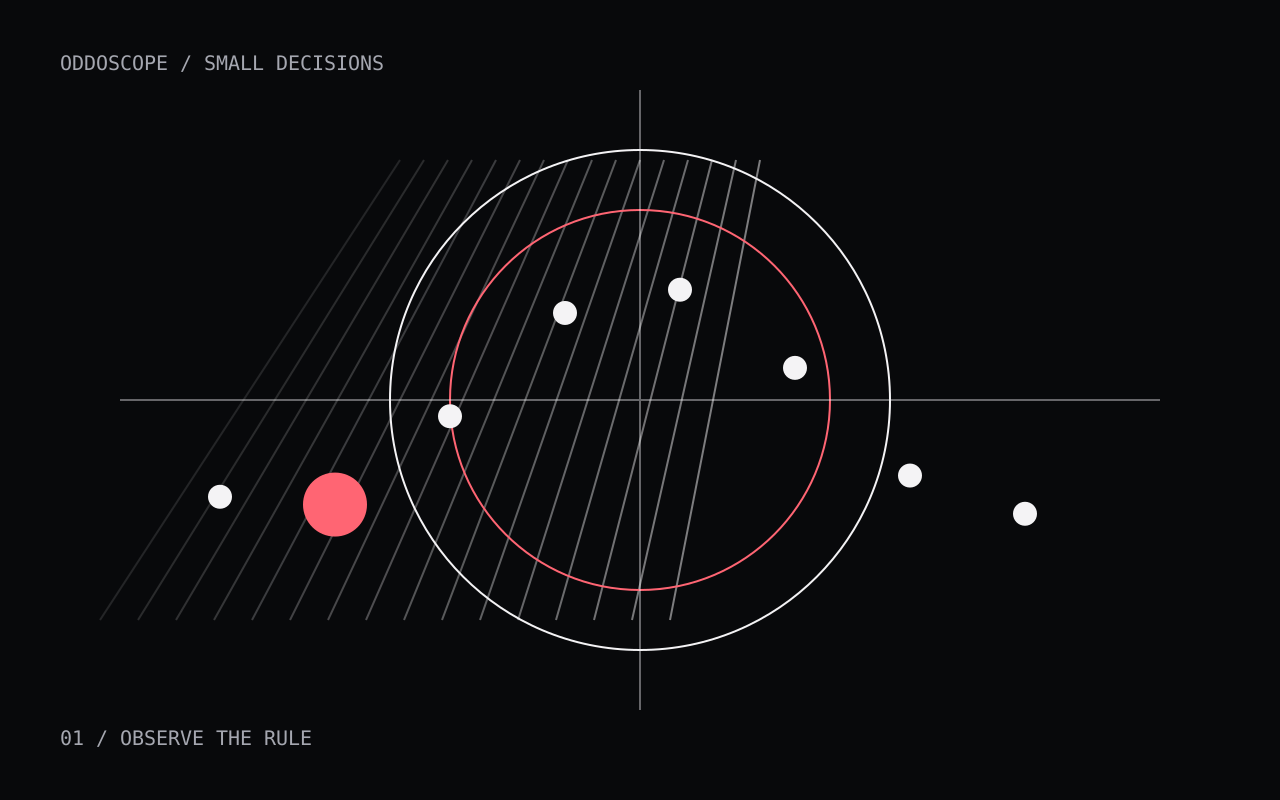
A room with two clocks
In this fictional repair shop, Mina can finish four units of work before lunch. The first customer needs a three-unit repair. Two later customers each need one unit. A sign promises first come, first served. Mina sees three waiting faces and considers changing the rule to finish the two quick jobs first. Two people would leave almost immediately. The customer who arrived first would spend another lunch break watching a machine that has still not been repaired. Which arrangement is better? The question has no answer until we decide what to count. Completed jobs, oldest waiting customer, promised deadlines and unfinished work are different measurements. They can disagree without anyone making an arithmetic mistake. A queue is not only the people visible from the door. It also contains commitments and work that has already begun.
Count work as well as heads
Imagine four people waiting, each with a one-unit job. Now imagine one person waiting with a four-unit job. A photograph makes the first room look worse. Under our invented equal-capacity assumptions, both rooms contain the same amount of work. They need not have the same experience: the second room has only one opportunity to complete a job, and interrupting that job may delay the only visible result. Little’s 1961 paper relates average work in a queuing system, arrival rate and time in the system under stated assumptions. It does not say that the shortest visible line is always quickest, or that every scheduling rule is fair. A four-minute snapshot is not a stable long-run average. Treat the relationship as a reason to define the system and the observation window, not as a magic calculator for an unfamiliar café.
The cost outside the frame
Return to Mina. Suppose moving between kinds of repairs consumes one work unit. A rule that repeatedly jumps to the newest small task can spend capacity on switching. Suppose instead that an urgent deadline applies to the old repair. Finishing more jobs may then miss a promise that the completion count does not record. These are additional fictional assumptions. They are not facts about all repair shops. Before proposing a faster queue in everyday life, write down what enters, what leaves and what counts as unfinished. Ask whether interruptions cost anything. Notice who remains after the quick successes have gone home. An average alone can hide that person. A completion total can hide them too. A useful dashboard shows both output and the remaining burden.
Take a rule into the room
Try this small exercise the next time a shared task list feels stuck: count unfinished work, not just the number of cards. Choose one outcome you want to improve and one promise you refuse to hide. You might track completed tasks alongside the age of the oldest unfinished task. You do not need precise forecasts to notice when one measure improves while the other gets worse. The Queue Room lets you allocate a fixed capacity using three rules over four shifts. It will show the resulting backlog and waiting burden. There is no prize for finding a supposedly moral algorithm. The useful result is being able to say which cost your chosen rule moved, where it moved it, and which assumptions made that movement possible.
Sources and editorial notes
John D. C. Little — A Proof for the Queuing Formula (1961) — Primary mathematical paper. Its stationary, finite-average assumptions matter; our four-shift toy is not a test of the theorem.
Original Oddoscope writing and artwork. All scenarios and numbers are fictional teaching examples; sources are credited, not reproduced.